Christmas Baby Elephant Redwork: A Business Design Review
As an embroidery designer who has reviewed hundreds of machine embroidery designs for small business merch, I approach every file with a critical eye. Is it production-ready? Will it hold up on a cap front? Does it reinforce brand identity or work against it? When I opened the Christmas Baby Elephant Redwork digital embroidery file, I immediately recognized a design with genuine commercial potential. But like any embroidery file, it has strengths and limitations that every business owner, apparel decorator, and Etsy seller needs to understand before stitching it onto uniforms, patches, totes, or branded products.
First Impression: Friendly, Rustic, and Surprisingly Versatile
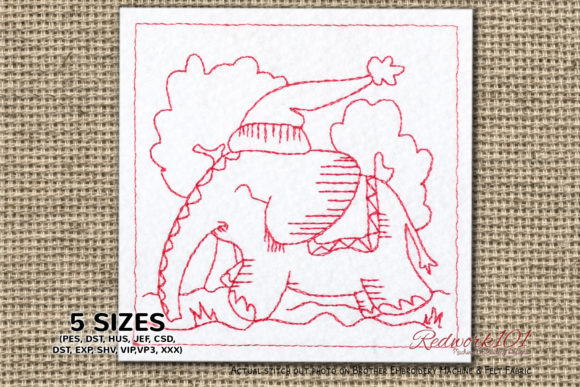
The Christmas Baby Elephant Redwork design reads as playful yet polished. The redwork style gives it a hand-drawn, storybook quality that feels both nostalgic and approachable. For a small business, this is a strategic advantage. A design that looks too mass-produced can feel cold, while something that appears handmade builds trust and emotional connection. This elephant strikes that balance. It is not overly detailed or fussy, which means it reduces the risk of thread breaks or registration issues during production. The redwork aesthetic also keeps thread colors minimal, which is a practical win for commercial embroidery projects where every color change adds time and cost.
The optional Box Stitch mentioned in the product description deserves attention. The outer box can be a different color, or you can skip it entirely. This flexibility matters when you are designing for multiple applications. On a tote bag design, the box can anchor the elephant and create a clean product label look. On a cap embroidery, skipping the box keeps the design compact and avoids crowding on a curved surface. As a designer, I appreciate any file that gives me this level of control without requiring manual digitizing edits.
How Christmas Baby Elephant Redwork Performs in Real Business Use
Let us walk through the specific applications a small business might consider. This design is not just a holiday decoration; it is a brand asset.
Embroidered Patches for Merchandise and Branded Labels
Patches are one of the most popular formats for small business merch because they can be applied to almost anything without stitching directly on the product. The Christmas Baby Elephant Redwork design is well-suited for patch production. The redwork style uses clean, continuous lines rather than heavy fills, which keeps the patch flexible and easy to sew onto hats, aprons, or bags. The optional box gives you a natural border, eliminating the need for a merrowed edge if you prefer a stitched outline. I recommend testing this design at two patch sizes: a larger 3-inch patch for jacket backs or tote bags, and a smaller 1.5-inch version for cap fronts or sleeve accents. The elephant motif should hold its clarity at both scales, provided the original digitizing has appropriate stitch density.
Apron Embroidery for Cafés, Bakeries, and Florists
Staff uniforms are a direct reflection of brand identity. A café, bakery, or florist using Christmas Baby Elephant Redwork on aprons sends a message of warmth, creativity, and attention to detail. The redwork style reads beautifully on cotton or linen aprons, especially in natural or neutral colors like cream, tan, or soft gray. Because the design is not heavily saturated with thread, it will not weigh down lightweight apron fabric or cause puckering. I suggest positioning it as a chest accent, roughly 2 to 2.5 inches wide, where it becomes a subtle but memorable brand mark. For seasonal promotions or holiday pop-ups, this design can be stitched in a festive red thread that matches your brand palette while still feeling special.
Cap Embroidery and Curved Surface Considerations
Caps are one of the trickiest surfaces for any machine embroidery design. Curved fronts, structured foam backing, and limited hoop space demand a design that compresses well. Christmas Baby Elephant Redwork has a compact silhouette, which is a good sign. However, I advise caution with the optional box stitch on caps. A box that extends too close to the edge of the cap front can distort or disappear under the curve. Test the design without the box first, or ask your digitizer to create a cap-specific version with reduced width. The elephant alone, centered on the front panel, makes a charming and professional mark for a pet brand, children's boutique, or creative studio.
Tote Bag Design for Retail Merchandise and Customer Gifts
Tote bags are the workhorse of small business merch. They are affordable to produce, easy to customize, and customers actually use them, which means your brand identity travels. The Christmas Baby Elephant Redwork design works beautifully on totes because the redwork lines stand out against natural cotton canvas without requiring a heavy stitch count. For a branded product line, you could pair the elephant with your business name in a complementary font, placed either below the elephant or inside the box if you choose to use it. I recommend a hoop size that allows the design to sit at least 2 inches below the bag top for proper centering. Test your stabilizer choice on a scrap bag first; medium-weight cutaway stabilizer usually provides the best balance for tote bag embroidery.
Work Shirts, Uniforms, and Branded Apparel
For businesses that want staff uniforms or employee gifts, the Christmas Baby Elephant Redwork design can serve as a chest logo accent or sleeve detail. The redwork style reads as premium and intentional without being overly corporate. A local pet store, creative studio, or handmade product brand could use this elephant as a signature mark on polo shirts, henleys, or denim shirts. I recommend positioning it on the left chest, approximately 2.5 to 3 inches wide, to maintain proportion. Test it on your actual uniform fabric before committing to a full production run, especially if the fabric has texture like pique knit or twill. Redwork designs can sink into textured fabric if the stitch density is too low, so verify that the details remain crisp after stitching.
Where to Use This Design Carefully
No embroidery design is perfect for every surface. Christmas Baby Elephant Redwork has specific limitations that every small business owner should plan for.
Small Patch Sizes and Fine Details
If you plan to use this design as a tiny product label or mini patch under 1.5 inches, inspect the digitizing closely. Redwork relies on continuous outlines and occasional detail lines. At very small sizes, those lines can become muddy or break apart. Ask your digitizer or embroidery file provider for a stitch-out at your target size before approving the design for commercial embroidery. If the details do not hold, consider enlarging the design or simplifying the motif for smaller applications.
High Stitch Density and Fabric Texture
Although redwork typically uses fewer stitches than fill-heavy designs, the optional box stitch can add density, especially if the box is a different color and requires a second pass. Test the design on your chosen fabric to ensure the box does not cause distortion or stiffness. On lightweight fabrics like silk or fine cotton, the box may need to be skipped entirely. On heavy fabrics like denim or canvas, the box can provide a clean frame, but confirm that the stabilizer is strong enough to support the additional stitches. I always recommend a medium to heavy cutaway stabilizer for fabrics with any stretch or texture.
Dark Uniforms and Low-Contrast Thread Choices
Redwork traditionally uses red thread on a light background. If your brand uniforms are dark, such as navy, black, or forest green, the red thread may not provide enough contrast to make the design readable from a distance. Consider switching to a lighter thread color like white, cream, or gold, or use the optional box in a contrasting color to frame the elephant. Always create a printable mockup before production to visualize the contrast. Your embroidery file provider may be able to adjust thread colors in the digitized file, but confirm that the design is not tied to specific color stops before making changes.
Frequent Washing and Long-Term Durability
For items that will be washed frequently, such as staff aprons or work shirts, the longevity of Christmas Baby Elephant Redwork depends on thread quality and stabilizer choice. Redwork designs with long, continuous stitches can be prone to pulling or snagging if the thread is not high-quality polyester or rayon. I recommend using a commercial-grade thread and a cutaway stabilizer that will not break down after repeated wash cycles. Test wash a sample item to see how the design holds up. If stitches begin to loosen or distort, adjust your stabilizer or stitch density before producing the full order.
How This Design Affects Brand Identity and Customer Trust
The Christmas Baby Elephant Redwork design is more than a decorative motif. It becomes part of your brand identity. When a customer sees this elephant on an apron, a tote bag, or a patch, they associate your business with qualities like creativity, warmth, and attention to detail. The redwork style specifically reads as handmade and intentional, which is a powerful signal for small businesses competing against mass-market brands. Customers who value craftsmanship and originality are more likely to trust a brand that invests in custom embroidery.
For an Etsy seller or handmade product brand, this design can become a signature mark that appears on every item. Consistency in your design assets builds recognition. If you use Christmas Baby Elephant Redwork on your product labels, packaging accents, and promotional merch, customers will begin to associate that elephant with your brand. Over time, that visual consistency translates into loyalty and word-of-mouth referrals.
However, brand identity depends on execution. A poorly stitched design, regardless of how charming the artwork is, will damage customer trust. Puckered fabric, broken threads, or misaligned details make a business look unprofessional. That is why I always tell my clients: test everything before production. Stitch out the design on your actual fabric. Create a printable mockup for client approval. Confirm that the embroidery file is properly digitized for your specific machine and hoop size. Do not skip these steps, especially when using a new design for commercial embroidery projects.
Practical Embroidery Designer Notes for Production Success
Before you commit to a full production run with Christmas Baby Elephant Redwork, here is my checklist for small business owners and apparel decorators.
Test it in black and white first. Ask your digitizer or embroidery file provider for a grayscale preview or a single-color stitch-out. This lets you evaluate the line work, spacing, and overall composition without being distracted by color. If the design reads clearly in black and white, it will read clearly in any thread color you choose.
Check if it works at small patch size. Order a sample patch at your target size before committing to a bulk order. Measure the design width and height, and confirm that the elephant remains recognizable and the details stay crisp. If the design loses clarity at small sizes, enlarge it or choose a different placement.
Review thread color contrast carefully. The optional box stitch can be a different color than the elephant, which adds visual interest but also increases thread changes. Plan your color stops in advance and verify that the contrast works on your chosen fabric. A red elephant with a green box may look festive, but ensure both colors are visible against your background.
Inspect spacing and alignment. The description notes that the outer box color may differ unless it is part of the design. Confirm that the box is properly centered around the elephant and that there is adequate negative space. Crowded designs look messy and are harder to read from a distance.
Confirm hoop size before production. Different hoop sizes accommodate different design dimensions. Ask your embroidery file provider for the exact hoop size required for this design at various scales. If you plan to stitch the design on caps or sleeves, you may need a smaller hoop or a different file format.
Test on real fabric with proper stabilizer. Do not rely on digital previews alone. Stitch out the design on the actual fabric you plan to use, with the stabilizer you will use in production. Evaluate the stitch quality, fabric distortion, and overall appearance. Adjust your settings or stabilizer choice as needed.
Create a mockup for client approval. If you are producing this design for a client, provide a printable mockup that shows the design on the actual product. This eliminates surprises and ensures that both you and the client agree on placement, size, and color before production begins.
Confirm commercial licensing before business use. Not all digital embroidery files come with commercial use rights. Verify that your purchase of Christmas Baby Elephant Redwork includes permission to use the design on products you sell. If the license is limited to personal use, contact the designer to negotiate a commercial license. Using a design without proper licensing can lead to legal issues and damage your brand reputation.
Final Verdict: A Strong Addition to Your Design Assets
Christmas Baby Elephant Redwork is a well-conceived machine embroidery design with real potential for small business merch, branded patches, and custom apparel. Its redwork style offers a handmade aesthetic that builds trust and recognition, while its optional box stitch provides flexibility for different product applications. The design is not without limitations, small patches, curved surfaces, and textured fabrics require careful testing, but these are manageable with proper planning and quality control.
For cafés, bakeries, florists, pet brands, creative studios, and handmade product sellers, this elephant can become a signature brand mark that elevates your merchandise and strengthens your brand identity. Approach it with the same care you would any commercial embroidery project: test, adjust, and confirm before production. When executed well, Christmas Baby Elephant Redwork delivers a finished product that customers will notice, remember, and trust.